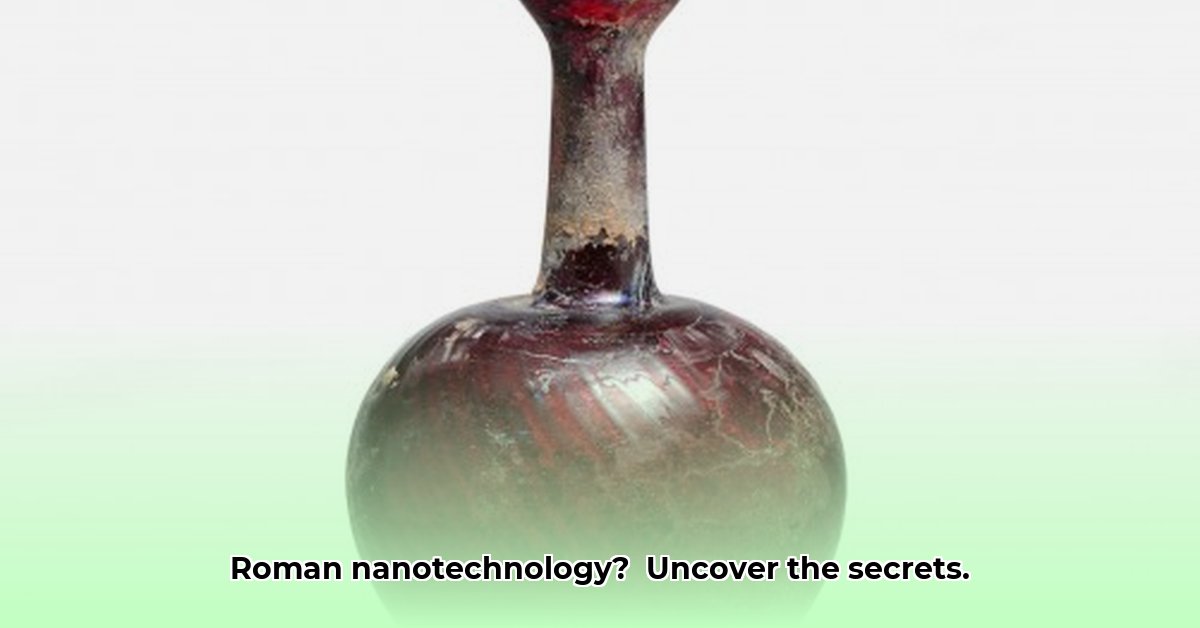
The Lycurgus Cup: A Time-Traveling Kaleidoscope
Imagine a Roman goblet, shifting magically from a shimmering emerald green to a deep ruby red depending on the light source. This is the Lycurgus Cup, a 1600-year-old artifact that captivates with its mesmerizing color-changing ability. Its secret lies not in sorcery, but in surprisingly sophisticated Roman nanotechnology – a mastery of manipulating materials at an incredibly small scale, far ahead of its time. This dichroism (a color change based on viewing angle) is a result of tiny gold and silver nanoparticles, far too small to be seen by the naked eye, embedded within the glass itself. How did Roman artisans achieve this feat? The answer remains a compelling puzzle. For more on Roman glass, check out this article on red glass.
Unlocking the Secrets of Roman Glassmaking
The Lycurgus Cup's magic trick is explained by the interaction of light with the gold and silver nanoparticles, approximately 50 nanometers (50 billionths of a meter) in size, dispersed within the glass. These nanoparticles scatter and absorb light differently depending on the direction of illumination, resulting in the dramatic color shift. But did the Romans understand the science behind this effect? Did they possess a deliberate method for creating nanoparticles, or did they stumble upon this remarkable phenomenon through experimentation? The answer is likely a combination of both.
"The precise control over nanoparticle size and distribution suggests a level of understanding or, at the very least, an unexpected degree of technical skill," says Dr. Anya Petrova, Materials Scientist at the University of Oxford. "Their methods remain a mystery, but the consistency of the effect across similar, though rare, artifacts indicates a degree of technical mastery." The research continues to explore the possibilities of accidental discovery versus advanced technological knowledge. Was it a serendipitous finding refined over time or part of a deeper understanding of material science that has been lost to history?
From Ancient Wonder to Modern Marvel: Modern Applications
The Lycurgus Cup's significance extends far beyond its aesthetic appeal. Its unique optical properties are highly relevant to modern nanotechnology. By studying how light interacts with the ancient nanoparticles, scientists are gaining valuable insights for developing highly sensitive sensors and advanced materials.
"The Lycurgus Cup’s remarkable properties are informing the creation of new sensors with unparalleled sensitivity," explains Dr. Jian Li, Nanotechnology Researcher at MIT. "We're learning to harness these principles to detect minute quantities of substances for applications ranging from environmental monitoring to early disease detection." This ancient technology is proving to be a crucial source of inspiration for groundbreaking modern applications.
The Future is Bright (and Possibly Dichroic): Ongoing Research
The Lycurgus Cup's legacy continues to inspire research across several disciplines:
Materials Science: Researchers are striving to replicate the Roman method for creating stable, color-changing nanoparticles. This could lead to the development of new materials with enhanced durability and optical properties.
Nanotechnology: The cup's optical characteristics are driving innovations in sensor technology, with the potential to revolutionize various fields, including medicine and environmental science.
Museum Conservation: Developing advanced preservation techniques is crucial to safeguarding this invaluable piece of history and similar artifacts for future generations.
How to Replicate Lycurgus Cup Nanotechnology Techniques: Unraveling the Mystery
The Lycurgus Cup poses a significant challenge to modern scientists: how did the Romans achieve such remarkable control over nanoparticle size and distribution? While we understand the effect (nanoparticles interacting with light), the method remains elusive. Intriguingly, the consistent color-changing effect throughout the cup points towards a deliberate manufacturing process, rather than a lucky accident.
"The replication of the Lycurgus Cup’s nanostructure remains a considerable challenge," states Dr. Marcus Jones, Archaeologist, British Museum. "The lack of contemporary textual evidence forces us to rely on meticulous scientific analysis and informed speculation." Research teams are employing techniques such as electron microscopy and X-ray analysis to analyze the cup's composition and structure, seeking to uncover the ancient method.
The potential payoff is significant. Unlocking the Roman techniques could lead to advancements in materials science, enabling the creation of new materials with similar optical properties and enhanced functionalities. The pursuit is not solely historical; it has the potential to impact several modern technological fields.
A Legacy of Innovation: Ancient Wisdom, Modern Applications
The Lycurgus Cup is a compelling testament to the ingenuity of Roman artisans and the enduring relevance of ancient technologies. Its continued study provides valuable insights, inspiring advancements in materials science and nanotechnology. This artifact serves as a powerful reminder that scientific and technological progress is a continuous journey, with discoveries from the past illuminating the path forward.